

Introduction
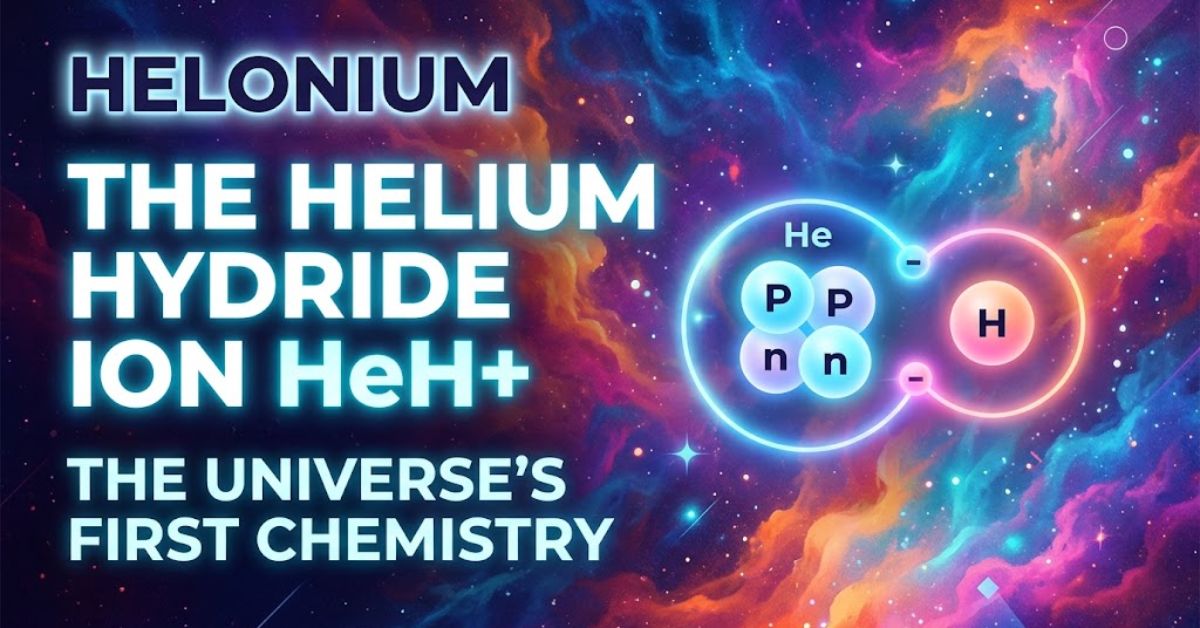
Helonium is a fascinating chemical species that helps scientists understand how chemistry began in the early universe. Commonly associated with the helium hydride ion (HeH⁺), helonium represents an important step in the history of molecular formation after the Big Bang. This positively charged molecule consists of one helium atom and one hydrogen nucleus, making it a unique example of how simple atoms can combine under the right conditions. Scientists believe HeH⁺ was among the first molecular ions to form as the universe cooled and expanded. Its study offers valuable clues about early cosmic chemistry, stellar environments, and the formation of more complex molecules. In this article, we explore what helonium is, how it forms, why it matters, and how modern astronomy has helped researchers detect it in space.
What Is Helonium?
Helonium is a term associated with the helium hydride ion, written as HeH⁺. This molecular ion contains one helium atom bonded to one hydrogen nucleus, which has a positive charge. Unlike ordinary neutral molecules, HeH⁺ carries an overall positive electrical charge because it has one fewer electron than a neutral combination of helium and hydrogen would have. Its unusual structure makes it important in both chemistry and astrophysics.
Helium is known for its chemical stability because its outer electron shell is full. However, under suitable conditions, helium can form a bond with a hydrogen nucleus, creating HeH⁺. This bond is unusual because helium generally resists forming chemical compounds. The helium hydride ion is therefore an important subject in molecular physics, quantum chemistry, and studies of the early universe.
The term helonium may also appear in informal scientific discussions and online articles. However, HeH⁺, or the helium hydride ion, is the established scientific name for the species most commonly discussed in this context. Understanding this distinction helps readers separate accepted chemical terminology from less formal naming. Researchers use HeH⁺ to study molecular reactions, energy transfer, and the earliest stages of chemical evolution.
Why Is Helonium Important in the Early Universe?
The early universe was extremely hot and dense. After the Big Bang, it gradually expanded and cooled, allowing particles to combine into atoms. Hydrogen and helium became the most abundant elements, creating the basic ingredients for the first chemical reactions. As temperatures and conditions changed, researchers believe helium hydride ions formed through reactions involving neutral helium and positively charged hydrogen.
HeH⁺ is considered a leading candidate for the first molecular ion formed in the cooling universe. Its creation marked an important stage in cosmic chemistry because molecules enabled new pathways for energy exchange and later chemical reactions. These processes helped establish conditions that eventually supported the formation of molecular hydrogen, an important coolant in primordial gas clouds.
However, the early universe did not immediately produce planets, stars, or complex organic molecules. Instead, basic chemical reactions developed over long periods. Studying helonium helps scientists investigate this transition from simple particles to molecular structures. Although HeH⁺ alone did not create the universe’s later complexity, its chemistry provides valuable evidence for understanding how the earliest molecular systems developed.
How Does the Helium Hydride Ion Form?
Helonium forms through chemical reactions that involve helium and hydrogen under suitable physical conditions. One important reaction occurs when a helium atom reacts with a proton, which is a positively charged hydrogen nucleus. The result is HeH⁺, a molecular ion held together by an electrostatic bond. This reaction can occur in hot astrophysical environments where energetic particles and ionized gas are present.
The formation and destruction of HeH⁺ depend on temperature, gas density, radiation, and the availability of other particles. For example, free electrons can contribute to reactions that destroy the ion, while collisions with other particles can change its abundance. Scientists use laboratory experiments and theoretical calculations to measure these reaction rates and improve models of cosmic chemistry.
In the early universe, HeH⁺ could react with neutral hydrogen to help produce molecular hydrogen through a pathway involving the transfer of a proton. Molecular hydrogen later became important in cooling primordial gas clouds, allowing gravity to draw material together and support the formation of the first stars. This connection makes helonium valuable for understanding how basic chemical reactions influenced the development of the universe.
How Was Helonium Discovered in Space?
Scientists had predicted that helium hydride ions should exist in space for many years. However, detecting them proved difficult because the ion produces radiation at specific wavelengths that can be challenging to observe through Earth’s atmosphere. Researchers needed instruments capable of identifying its distinctive spectral signature among emissions from other atoms and molecules.
In 2019, an international research team reported the first confirmed astronomical detection of HeH⁺ in the planetary nebula NGC 7027. The discovery was made using the Stratospheric Observatory for Infrared Astronomy, known as SOFIA. This airborne observatory carried a specialized infrared instrument that could observe wavelengths difficult to study from the ground. The finding provided direct evidence that HeH⁺ exists in an astronomical environment.
The detection was significant because it confirmed a long-standing prediction about the chemistry of space. NGC 7027 is a hot, compact nebula containing gas exposed to intense radiation from a central star. These conditions support chemical reactions that can produce HeH⁺. Although this observation did not directly capture the first molecules formed after the Big Bang, it helped researchers test their understanding of helium hydride chemistry in real cosmic environments.
What Makes Helonium Different From Ordinary Helium?
Ordinary helium is a neutral chemical element with two protons and two electrons. Its electron arrangement makes it highly stable, which explains why it rarely forms chemical bonds under normal conditions. Helonium, when referring to HeH⁺, is different because it contains a helium atom bonded to a hydrogen nucleus and carries a positive charge.
This charged structure gives HeH⁺ properties that differ from those of neutral helium gas. It can absorb and emit radiation at characteristic frequencies, allowing astronomers to identify it through spectroscopy. Its molecular behavior also depends on the surrounding environment, including temperature, pressure, radiation, and collisions with other particles.
The comparison is important because it shows that chemical stability does not mean an element can never participate in a bond. Under the right conditions, even helium can form a molecular ion. Research into HeH⁺ also helps scientists test quantum mechanical models, which describe how electrons and atomic nuclei behave at very small scales. These insights are useful beyond astronomy, contributing to a broader understanding of molecular structure and chemical reactions.
Where Can Helonium Be Found Today?
Helonium is not limited to theories about the early universe. Scientists have detected HeH⁺ in the planetary nebula NGC 7027, where hot gas and intense ultraviolet radiation create conditions favorable for its formation. Planetary nebulae develop when certain stars release their outer layers near the end of their lives. Despite the name, these nebulae are not planets.
The presence of HeH⁺ depends on local physical and chemical conditions. It may form in regions where helium is ionized and hydrogen nuclei are available, but its abundance can remain low because other reactions destroy it. Detecting the ion therefore requires sensitive instruments and accurate predictions about its spectral lines.
Researchers continue to investigate molecular ions in different astrophysical environments to understand how chemical reactions vary across space. HeH⁺ offers a useful example because scientists can compare laboratory measurements, theoretical models, and astronomical observations. These comparisons help improve our understanding of stellar evolution, ionized gas, and the chemistry that operates in regions far beyond our solar system.
Frequently Asked Questions About Helonium
1. What is helonium in simple terms?
Helonium commonly refers to the helium hydride ion, HeH⁺. It is a positively charged molecular ion made of a helium atom bonded to a hydrogen nucleus.
2. Is helonium the first molecule in the universe?
HeH⁺ is widely regarded as a leading candidate for the first molecular ion formed in the early universe. Its formation was an important step in the development of cosmic chemistry.
3. Who discovered helonium in space?
An international research team announced the first confirmed astronomical detection of HeH⁺ in 2019. Scientists used the SOFIA airborne observatory to identify it in the planetary nebula NGC 7027.
4. Why is helium hydride important to astronomy?
HeH⁺ helps researchers understand early chemical reactions and the physical conditions inside nebulae. Its detection also allows scientists to test theoretical models of molecular chemistry.
5. Can helonium exist on Earth?
HeH⁺ can be produced and studied under controlled laboratory conditions. However, it is highly reactive and is not a stable, everyday substance like ordinary helium gas.
Conclusion
Helonium, most commonly discussed as the helium hydride ion (HeH⁺), offers a remarkable window into the origins of chemistry. Its unusual bond between helium and hydrogen demonstrates how simple particles can form molecular structures under the right conditions. Scientists consider HeH⁺ an important part of early-universe chemistry because it helped establish reaction pathways associated with the formation of molecular hydrogen. Its confirmed detection in the planetary nebula NGC 7027 in 2019 also showed that this unusual ion exists in space today. By studying helonium through laboratory experiments, spectroscopy, and astrophysical models, researchers continue to improve our understanding of molecular formation, stellar environments, and the chemical processes that shaped the evolving universe.
